In the novella, a Christmas Carol, Ebenezer Scrooge observes, “I will honour Christmas in my heart, and try to keep it all the year. I will live in the Past, the Present, and the Future. The Spirits of all Three shall strive within me. I will not shut out the lessons that they teach.” This is a good lesson for all of us, but I would say that right now I am in the season of Lent. This is a season of fasting and prayer that comes right before Easter. It is considered a period of deep somber sobriety much like the dour-faced pilgrims at worship or the expression worn by many Cincinnati Reds’ fans after a game.
Lent is not really viewed as the happiest of times. It is after all commemorating Jesus’ forty days in the wilderness being tempted by Satan, which one can assume would not be the most enjoyable time spent. Many Christians give up things for Lent just as Jesus did by going into the wilderness. While I believe their intentions are pure on conscious level, I think perhaps giving something up for Lent as a sort of sign, is problematic. (The Lutheran in me recoils at anything the vaguely smells of work’s-based-righteousness.) If you are to give up anything for Lent, I believe it should be unknown to anyone around you if it is to be for God’s glory; and if you are to give it up for your benefit (i.e. smoking or sugar), don’t you believe you should give it up totally for your health. Things that are to be done for the “good” should need no special time of year to mark them; and become a sort of “sanctified New Year’s resolution.” I think this might lower God to a bit o a totem.
No, the real meaning of Lent is hardly anything to be sad or mournful about at all. The real meaning Lent is about a promise … or maybe a series of promises that make a larger promise. Long ago, God told Noah that he would never destroy the world; but instead of stopping there, he set into motion a plan to save the world. The real meaning of Lent is about suffering, but never about a suffering that we were meant to bear by ourselves or even at all. The suffering that was endured was Christ’s for us. When we seek to punish ourselves by going without, we must always make sure we ask ourselves why we are suffering. Is it because of Christ or is it because of our pride? To give up something for Lent therefore will never be enough. It is only when we give something to God. When we tack on our problems and sins to the cross and the God-man that hung there, then and only then, will we be approaching the true meaning of Lent.
The name Lent has an interesting meaning. In most of the Romantic languages it is derived from the Latin: quadragesima. This means fortieth day, and the nomenclature has kept this up in most of the countries around Europe. In English however, we use the term Lent. This derives from the Anglo-Saxon root word that means “long.” It its connotation means “spring.” I think this is the best way to describe this season. It is a season of painful changes and eternal promises that eventually leads to the long-ago promise of life once again. It is a time when God will make all things new and when we finally realize that winter will not last forever.
Wednesday, February 25, 2009

Friday, February 20, 2009
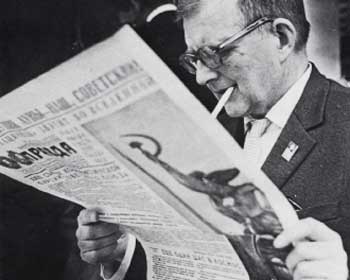
Shostakovich is my Homeboy!
I can still remember when Fantasia 2000 came out in theaters. I practically begged everyone to go see it with me, but to no avail. Later, when it came out on DVD, I was dazzled by the inventiveness of the use of music and imagery. It is one great film and I recommend it to anyone who wants to see great imagination on screen.
I had never lost my love for classical music. I had listened to it when in middle school primarily as background music for papers. However, when I listened to Shostakovich’s Piano Concerto, I became a lifelong fan. Shostakovich combines so many things in his music. It is orderly and yet feels avant-garde. It appears very simple to play, and yet I am told his pieces are amongst the hardest. His life, like his music was filled with contrasts fueled by a sort of pragmatism.
Living in Communist Russia, one had to always live with such contradictions. You never were really sure which end of the monster you were going to be on from day to day. Because of this, and his being Russian, he is widely ignored by most of us in the U.S.[1] While he has been lambasted by some. One musical theorist said Shostakovich “made no secret of his debt to Mahler and many other composers: Bach, Stravinsky, jazz and popular music, Jewish and Russian folk music. But was the music of Beethoven not rooted in the music of Mozart and Haydn? Of course it was. But did it not evolve into something entirely different - something that is unmistakably Beethoven? Of course, it did. And who can deny that the symphonies of Shostakovich, taking their starting point from Mahler, developed into an entirely different musical idiom that is unmistakably Shostakovich and nobody else but Shostakovich?”
And that is the best that can be said of anyone. There will never be anyone like Dmitri Shostakovich or me or you. Who knows years later, someone may come across some scrap I have written, like it very much, and put it in a movie, book, story, or what have you. If you just put things out there, you never can be sure who is listening.
[1] It also doesn’t hurt that Copland and Gershwin are easier names to pronounce. Then again, how many of us would actually pronounce Beethoven (ˈbā,tōvən)if we hadn’t had it drilled into our heads by legions of music teachers?
Friday, February 13, 2009
In The World of My Stress.
On my way to work today I felt pretty stressed. It usually happens to me. However, my problems are hardly insurmountable and my fears hardly warranted. Indeed, I do not know of anyone who has had warranted fears. Fear, for me at least, comes about when I am jarred from peace. However, I have been looking for outward peace to substitute inner peace. And when we try and substitute the definition of happiness for peace we are letting ourselves in for a great deal of sadness, disappointment, and of course stress.
We live in a harried and archipelic[1] world. It is a world where stress is ours to own, to keep, to hold in ourselves. In life, however, we do not know how to deal with stress. There are two things I know about stress:
1) Each person has a unique language as to how their stress writes itself in one’s life.
2) Stress must either move and be held in your psyche or pass through it. If too much passes through, you are probably not taking things seriously enough. If too much is bottled up … well, I needn’t tell you how damaging that can be to someone.
Stress is a lot like water: powerful and peaceful. It has many different qualities, properties, stages, and even contents[2]. In my life, I internalize my stress. I let it become stagnant in my heart. Instead, I need to let it pass by like a river stream. Cool, forward moving without chaotic and devastating rushes; a stream brings life and purpose to all that is around it. To stop the flow is to be in painful stagnation.
This is the first stage for me to understand stress. I will discuss the improper defining of peace as happiness and how I should handle my stress differently in my next blog posts. Right now, I need to get ready for work.
[1] That is a world of archipelagos. Don’t look it up, I felt like making a word.
[2] Water picks up silt or salt or many other things. They aren’t water, but they make a body of water that body just as much as the water itself. Stress is unique in its contents as well. Stress of love or work is very different.
Thursday, February 12, 2009
(Again I am barely conscious. Enjoy the post, ignore the errors.)
The Comical Failure
Every time I see St. Peter’s Basilica in Rome, I chuckle a little. It is an impressive building and one of the greatest pieces of architecture in the world; but as for the cost of its building … well, that’s so large, I think only God knows. You see in 1517, a German monk named Martin Luther posted 95 problems on the door of the local church. (Doors of churches were places where public announcements and such were placed.) He wrote them in Latin so that it would be a scholarly debate. The focus of the questions was on the sale of plenary indulgences. Though, it’s a bit confusing, these were documents sold so that people could get themselves or their loved ones out of afterlife punishment.[1] Now, selling indulgences to for Church projects was, alas, nothing new. However, Luther was one of the few to actually have challenged it. These particular indulgences were being sold so as to build … you guessed it … St. Peter’s. The outcome is the same one that has plagued faith and religion since the dawn of time. One person asks a question, this forces the powers that be to fight back, and the person positing the question looks deeper to find out if he or she is indeed right. Rome’s intransigence forced Luther to delve deep into scripture to understand his point of view. Rome could’ve saved face, most of Northern Europe, and several millions of members if it would’ve admitted it was wrong; but it couldn’t sacrifice its pride. It won the basilica in the end, but lost its way.
Indulgences were something I thought faded into the mists of history. I figured Rome had learned its lesson and quietly dismantled the foolish belief until an history professor brought in one that he had bought at a yard sale. This one was issued back in the 1950s. You see Roman Catholic dogma will not let things disappear. If the church were to err, than their entire religion would be in err. Protestants admit that their leaders are more right than wrong, but that these leaders were fallible humans just like any other schmuck. The Bishop of Rome however has a dilemma, when he puts on holy relics and sits on the throne of Peter, his word is gospel and infallible. Even if Rome did believe it was in err, it could not go back on itself because that would undermine everything it has become and is.
In every healthy relationship, a person must admit he or she is wrong. Spouses must apologize to spouses, children to parents, and even sometimes parents to children. The church is no different. Sometimes we humans get it wrong. A verse gets mistranslated, a belief was influenced by a culture and not scripture, or a pastor just flubbed big time. Church is a place for sinners to get together and get better; but who can get better when no one admits when they are wrong? After all, isn’t that the first step in AA; admitting you have a problem?
Well, indulgences are kept around, but with a wink and nod that they really don’t mean anything. I can sort of live with that. I would have an hard time living with Catholicism knowing that I was living with them; but as long as no one took them seriously, I guess I would be okay … sort of … a bit. Not anymore though. The Catholic Church is now beginning to move them closer to the forefront declares the New York Times or at least not be silent about them. Yes, this is a direct challenge to Protestants; much like a bully gloating over its own stupidity. Whatever the Catholic Church may contribute in understanding becomes severely diminished by high-handed declarations.
However the more disturbing problem is the cost this has for the psyche of average believer. Is God’s grace and love to be bought or is it freely given? The Smalcald Articles, written by Luther, puts it like this:
The first and chief article is this: Jesus Christ, our God and Lord, died for our sins and was raised again for our justification (Romans 3:24-25). He alone is the Lamb of God who takes away the sins of the world (John 1:29), and God has laid on Him the iniquity of us all (Isaiah 53:6). All have sinned and are justified freely, without their own works and merits, by His grace, through the redemption that is in Christ Jesus, in His blood (Romans 3:23-25). This is necessary to believe. This cannot be otherwise acquired or grasped by any work, law or merit. Therefore, it is clear and certain that this faith alone justifies us ... Nothing of this article can be yielded or surrendered, even though heaven and earth and everything else falls (Mark 13:31).[45]
Our faith in God is not built with our works but with our faith. I would rather die for my faith than for my works. This was not something Luther and his protestant reformers created; it was in the scriptures all along waiting to be rediscovered. It feeds our egos to believe we can earn out way into heaven. If that were the case, than God is irrelevant and our own lives had better be the center. Yet how many Christians, Protestant as well as Catholic, believe that our works will earn us our salvation? How much stronger does this myth become when our churches reinforce it with bad teaching and bad examples?
Sin is still in the world, but the way to fight it is not with get out of jail free cards or new church dogma or strategies for growth. The way to fight sin is to rely on Christ to do what He said he would do, take the sin of the world onto Himself.
Luther’s war caused a schism in the church, but one that was desperately needed. It allowed for people to be found more easily by a God constantly reaching for them. Rome licked its wounds, but later moved closer and closer to the rest of the church.
It seems that today, however, it has chosen to go back to its old ways. The question is what new physical edifice will be erected as your spiritual edifice comes crashing down around your ears? What tangible monument to foolish pride will have been lifted up as you ignore the simple monument of a cross the promise made there that “your sins are forgiven?” Perhaps that failure isn’t comical at all.
[1] Actually it kind of goes like this: During the crusades, the popes said that anyone who fought the Muslims would go to heaven and get out purgatory. What’s purgatory you say? Purgatory is a place that doesn’t appear in scripture per se (and by per se, I mean not at all), but appears a lot in the tradition of the Catholic Church. It is a place where people are “purged” of their sins, hence the name purgatory. It is kind of a like refining someone so that you will be good enough to get into heaven. It isn’t pleasant apparently, because why else would people try and get out of it? However, not everyone was fit enough to go crusading, so the Roman Catholic Church said, “Okay, well, if you can’t go, we’ll take a donation that demonstrates your faith in the church. In return for this, we’ll send you the same piece of paper that crusaders are getting to get out of purgatory.” You can see the slippery slope. People left out thoughts of donations and justification, and focused only on the tit a tat viewing payment as a way to get out of punishment, and we know that’s not right!
Wednesday, January 14, 2009
OMG(osh)!
(Warning: I am extremely tired as I write this, but subconscious Phil is trying to say something and it is best to let him do his own writing. Conscious Phil is trying to proofread.)
There is nothing more pathetic than an adult trying to act like an adult. A child acting like an adult is cute, and an adult in touch with their inner child is enlightened; but an adult who tries to behave like an adult means they are neither what they are nor what they pretend to be.
- Me
Once upon a time, not so long ago, I was hanging out with my friend Andrew. Two desperate post college buds looking for some relatively harmless things to do, we began trying to find stuff to watch. Now, I know what you're thinking, most guys our age watch other things. Things which are as frivilous and putrid as can be comprehended; but somehow, and in someway, we just started watching animation. It is odd that in our day and time animation is regarded as something for children to watch. It is something we adults find beneath us: quaint, provential, but certainly no way to behave.
In our day to day lives,* it is ironic that we forget what it means to be us. Breadwinners and romantics often kill their humanity just to attempt to be human. It is not just pathetic, it is a sickness. We then try and act like children, but we have forgotten what it meant to be a child. We forgot that it meant to have faith, to love without the boundries of our conceptions, to dream stupid dreams and not have them mean utter disgrace and failure. I have entered the world of the false adult on this account, much to my embarrassment and chagrin.
In the end the adult is one who is in touch with what we Christians call the eternal now; and yet is in touch with it in more than just what we know. The Christian knows that the eternal now is a point in which time and space are compressed forever and ever into one, what the physicists would call, singularity. At each moment our lives enter a beautiful crossroads. Here time and space meld like stars into existence. Instead of pulling apart and compartmentalizing, labeling and categorizing our being; the human spirit realizes the happiness of the moment. That person knows time is an illusion of order and is only an utility created to assist in our endevors. That person doesn't reject time, but realizes that time is beneath the human psyche and spirit. There is no force or tool more powerful or important than the tiny unknowable nothingness/everything of one human soul. It is bigger and smaller than the universe, and that its power lies in its incomprehensibility.
It is the forgetting of the wonder we experienced as children that leads us to work jobs of minutia and unfulfillment. We long to laugh at simple joys of imaginary stories and castles and far away lands, to fight wars, to forget ourselves. I am not saying that childhood is perfect and that we should be children forever; but I am saying that to forget what we learned as children is dangerous and, more importantly, unpleasant.
It was in my, to use a cliche term, "an enlightened state" that I began to watch cartoons. A connection with the simpler times of being a child, it made me happy again; the simple kind of happiness that is as necessary as the complex and philosophical ones. Naruto and Deathnote and Avatar are the simple pleasures that our the last refuge of my complexes.
I write this post to say that I am an huge fan of Avatar. I just finished the last episode and am in complete awe of the imaginations that can keep people captivated for three years. I started watching the show in the very middle of the middle (episode 33 to be exact). When I began watching the show with my friend Andrew, we desperately tried to watch as many episodes as we could. We would record them on a DVR and play them back later on that night, drinking wine, and commenting on how great a story it was.
The show, I should mention, is about four peoples. Each people is linked to elements: earth, fire, air, and water. Some individuals in each culture can manipulate the element of their people. There is a unifying reincarnation that appears in a cyclical pattern to each of the peoples called the Avatar. The Avatar, in this generation, is helped by his friends to try and restore balance to an unbalanced world. Corny? Yeah, but who says there is anything wrong with being corny?
The funny thing is that when I talk to kids, I usually mention that I am an huge fan. I have let friend's of the family borrow my dvds or watched a few episodes with my friends who have kids. The result is always the same, they end up becoming as obsessed with the show as I am.
Is there a point to this blog post? It is pretty easy to spot. Usually I am much more structured and rational, but sometimes it is just important to really enjoy the beauty of creativity and the joy of creation. When we were young we would tell stories to parents and draw pictures with friends, when we got older we forgot the simple joy of our imaginations. So, pick up the phone or sit down at the computer and tell a friend a story you have had or share a work of fiction that you have heard/watched/read. Enjoy this simple part of your humanity; if not for me, than for that little child inside you.
*I know I use that phrase a lot, but in the minutia of day to day isn't it odd how we lose ourselves.
There is nothing more pathetic than an adult trying to act like an adult. A child acting like an adult is cute, and an adult in touch with their inner child is enlightened; but an adult who tries to behave like an adult means they are neither what they are nor what they pretend to be.
- Me
Once upon a time, not so long ago, I was hanging out with my friend Andrew. Two desperate post college buds looking for some relatively harmless things to do, we began trying to find stuff to watch. Now, I know what you're thinking, most guys our age watch other things. Things which are as frivilous and putrid as can be comprehended; but somehow, and in someway, we just started watching animation. It is odd that in our day and time animation is regarded as something for children to watch. It is something we adults find beneath us: quaint, provential, but certainly no way to behave.
In our day to day lives,* it is ironic that we forget what it means to be us. Breadwinners and romantics often kill their humanity just to attempt to be human. It is not just pathetic, it is a sickness. We then try and act like children, but we have forgotten what it meant to be a child. We forgot that it meant to have faith, to love without the boundries of our conceptions, to dream stupid dreams and not have them mean utter disgrace and failure. I have entered the world of the false adult on this account, much to my embarrassment and chagrin.
In the end the adult is one who is in touch with what we Christians call the eternal now; and yet is in touch with it in more than just what we know. The Christian knows that the eternal now is a point in which time and space are compressed forever and ever into one, what the physicists would call, singularity. At each moment our lives enter a beautiful crossroads. Here time and space meld like stars into existence. Instead of pulling apart and compartmentalizing, labeling and categorizing our being; the human spirit realizes the happiness of the moment. That person knows time is an illusion of order and is only an utility created to assist in our endevors. That person doesn't reject time, but realizes that time is beneath the human psyche and spirit. There is no force or tool more powerful or important than the tiny unknowable nothingness/everything of one human soul. It is bigger and smaller than the universe, and that its power lies in its incomprehensibility.
It is the forgetting of the wonder we experienced as children that leads us to work jobs of minutia and unfulfillment. We long to laugh at simple joys of imaginary stories and castles and far away lands, to fight wars, to forget ourselves. I am not saying that childhood is perfect and that we should be children forever; but I am saying that to forget what we learned as children is dangerous and, more importantly, unpleasant.
It was in my, to use a cliche term, "an enlightened state" that I began to watch cartoons. A connection with the simpler times of being a child, it made me happy again; the simple kind of happiness that is as necessary as the complex and philosophical ones. Naruto and Deathnote and Avatar are the simple pleasures that our the last refuge of my complexes.
I write this post to say that I am an huge fan of Avatar. I just finished the last episode and am in complete awe of the imaginations that can keep people captivated for three years. I started watching the show in the very middle of the middle (episode 33 to be exact). When I began watching the show with my friend Andrew, we desperately tried to watch as many episodes as we could. We would record them on a DVR and play them back later on that night, drinking wine, and commenting on how great a story it was.
The show, I should mention, is about four peoples. Each people is linked to elements: earth, fire, air, and water. Some individuals in each culture can manipulate the element of their people. There is a unifying reincarnation that appears in a cyclical pattern to each of the peoples called the Avatar. The Avatar, in this generation, is helped by his friends to try and restore balance to an unbalanced world. Corny? Yeah, but who says there is anything wrong with being corny?
The funny thing is that when I talk to kids, I usually mention that I am an huge fan. I have let friend's of the family borrow my dvds or watched a few episodes with my friends who have kids. The result is always the same, they end up becoming as obsessed with the show as I am.
Is there a point to this blog post? It is pretty easy to spot. Usually I am much more structured and rational, but sometimes it is just important to really enjoy the beauty of creativity and the joy of creation. When we were young we would tell stories to parents and draw pictures with friends, when we got older we forgot the simple joy of our imaginations. So, pick up the phone or sit down at the computer and tell a friend a story you have had or share a work of fiction that you have heard/watched/read. Enjoy this simple part of your humanity; if not for me, than for that little child inside you.
*I know I use that phrase a lot, but in the minutia of day to day isn't it odd how we lose ourselves.
Sunday, January 11, 2009
Unedited Rant Number 1
I was wanting to write something, but the muses only seem to visit me during the most impractical time and in the most impractical places. A car ride, a moment before sleep, in the middle of the work day; these are the times they visit me most. When I am in front of my computer screen, when I am faced with a million distractions that fail to distract me; these are the times when they abandon me to the vast nothingness and apathy that seem to be the units of the day. Great phalanxes of nothingness seem to crowd around me while everyone else pursues a dream or at least a dream of a dream.
I try and write when I cannot. I remember once I tried to write a paper for philosophy and muses stayed far away. Here I was a day or two ahead of schedule, and they wouldn't visit to me. The day before the paper, it seemed like there wasn't enough that could be written or said. Why is that? Why is the world so cruel as to make even the easy things hard? And why am I and an handful of others the only people that really care?
Why don't we treat our philosophers right? I suppose it is because we are all philosophers; and if we start acknowledging that truth, than we would have to treat everyone properly. I have met so many people who have bought into the myth of unkindness. They do not even have skin that is very thick at all. They are like bad actors trying to be so very unkind because they think that is what is required of an human being. Is acting like professional lying? Why is lying to ourselves and others so important to ourselves? I don't have any answers. I am hoping something triggers something and I can write.
The truth is I want to write something right now. I want to say something important only to me. No one else will care the way I do and I even realize that it doesn't really matter except to a small group of my friends. I want to shout and curse down the sun and the moon and all the satellites of the cosmos; but after the primeval yalp ... what will I have really done. Oh, to not think so very much; especially about a blog post.
I try and write when I cannot. I remember once I tried to write a paper for philosophy and muses stayed far away. Here I was a day or two ahead of schedule, and they wouldn't visit to me. The day before the paper, it seemed like there wasn't enough that could be written or said. Why is that? Why is the world so cruel as to make even the easy things hard? And why am I and an handful of others the only people that really care?
Why don't we treat our philosophers right? I suppose it is because we are all philosophers; and if we start acknowledging that truth, than we would have to treat everyone properly. I have met so many people who have bought into the myth of unkindness. They do not even have skin that is very thick at all. They are like bad actors trying to be so very unkind because they think that is what is required of an human being. Is acting like professional lying? Why is lying to ourselves and others so important to ourselves? I don't have any answers. I am hoping something triggers something and I can write.
The truth is I want to write something right now. I want to say something important only to me. No one else will care the way I do and I even realize that it doesn't really matter except to a small group of my friends. I want to shout and curse down the sun and the moon and all the satellites of the cosmos; but after the primeval yalp ... what will I have really done. Oh, to not think so very much; especially about a blog post.
Sunday, January 4, 2009
Contemplating Grey Skies or The Long Dark Teatime of the Soul.
In the end, it was the Sunday afternoons he couldn't cope with, and that terrible listlessness that starts to set in about 2:55, when you know you've taken all the baths that you can usefully take that day, that however hard you stare at any given paragraph in the newspaper you will never actually read it, or use the revolutionary new pruning technique it describes, and that as you stare at the clock the hands will move relentlessly on to four o'clock, and you will enter the long dark teatime of the soul.
--Douglas Adams, Life, the Universe and Everything
I got home today from a rather tough day at work. It can be really boring. Its the same people and we do the same stuff. We all have this feeling like we should be getting better and better and faster and faster, but in reality ... there is a point where one has to just be grateful that we have one another at all. On top of this, I am really tired. I have been going to bed late at night because I drove home from Lexington the night before last at about ten o'clock and was up reading a cook book (yes, a cook book; no, not "How to Serve Man"). The sky was gray, you know that horrible tint of terrible that one runs across from time to time. It feels as if the sky wishes to land and smother the world below like a beached whale on an unsuspecting surfer.
I tried to make it through like any red-blooded American would. I went shopping. I found a couple of cooking knives, some pots, some pans, a food processor, condiments, etc.; but there is a sort of cathartic apathy that ensues after the Christmas credit binge and I just didn't feel up to spending any more money. I drove home and tried to muster my thoughts and emotions and will (my platonic goodie basket called the psyche) into one good long prayer. The words come out, but sometimes it just feels like one is mumbling at the sky or ground or, in my case, the road straight ahead of me. I took stock of my life and found the truly painful truth, there is one thing that I believe.
I came home and the gray skies that I had left behind in the day time followed me home as I watched news that I disagreed with and talked over the same daily ennui that I had brought up countless times before.
A friend of mine said that we cannot rely on others for our happiness. This is true, but we cannot rely on ourselves either. My mind came back to the thought I had had in the car. I am cursed to be a Christian. It is the one thing that in which I believe, and I have tried to grow doubt in my heart and head, and it just gets crushed by the overpowering facts. In the end, what I have found is something very interesting. The more we lose, the more we have room for other things. Faith is not some promise that things are going to be rosy-colored sunshine days. Faith is a promise that there are bigger things than gray skies and ennui emotions. There are bigger things than the things we want. Faith is about the realization that we are aware that there are bigger things than ourselves. And it in a world that can be kind of boring, isn't it nice to know there are still things that make life a little more interesting.
--Douglas Adams, Life, the Universe and Everything
I got home today from a rather tough day at work. It can be really boring. Its the same people and we do the same stuff. We all have this feeling like we should be getting better and better and faster and faster, but in reality ... there is a point where one has to just be grateful that we have one another at all. On top of this, I am really tired. I have been going to bed late at night because I drove home from Lexington the night before last at about ten o'clock and was up reading a cook book (yes, a cook book; no, not "How to Serve Man"). The sky was gray, you know that horrible tint of terrible that one runs across from time to time. It feels as if the sky wishes to land and smother the world below like a beached whale on an unsuspecting surfer.
I tried to make it through like any red-blooded American would. I went shopping. I found a couple of cooking knives, some pots, some pans, a food processor, condiments, etc.; but there is a sort of cathartic apathy that ensues after the Christmas credit binge and I just didn't feel up to spending any more money. I drove home and tried to muster my thoughts and emotions and will (my platonic goodie basket called the psyche) into one good long prayer. The words come out, but sometimes it just feels like one is mumbling at the sky or ground or, in my case, the road straight ahead of me. I took stock of my life and found the truly painful truth, there is one thing that I believe.
I came home and the gray skies that I had left behind in the day time followed me home as I watched news that I disagreed with and talked over the same daily ennui that I had brought up countless times before.
A friend of mine said that we cannot rely on others for our happiness. This is true, but we cannot rely on ourselves either. My mind came back to the thought I had had in the car. I am cursed to be a Christian. It is the one thing that in which I believe, and I have tried to grow doubt in my heart and head, and it just gets crushed by the overpowering facts. In the end, what I have found is something very interesting. The more we lose, the more we have room for other things. Faith is not some promise that things are going to be rosy-colored sunshine days. Faith is a promise that there are bigger things than gray skies and ennui emotions. There are bigger things than the things we want. Faith is about the realization that we are aware that there are bigger things than ourselves. And it in a world that can be kind of boring, isn't it nice to know there are still things that make life a little more interesting.
Subscribe to:
Posts (Atom)